
About
At the Spring General Meeting 2020 the Irish Catholic Bishops’ Conference decided to embark on a synodal pathway for the Catholic Church in Ireland leading to the holding of a National Synodal Assembly within the next five years.
Background
Since the 2018 Ordinary General Assembly of Bishops in Rome on the theme of young people, the faith and vocational discernment, bishops had been giving active consideration to calling a National Synodal Assembly for the Church in Ireland. Conversations at local, regional and national level have informed the work of a subgroup of the Episcopal Conference which was established to explore the idea further. During the 2020 Winter General Meeting of the Bishops’ Conference they decided to proceed along a synodal pathway, and, since then, have been assisted and greatly encouraged by Cardinal Grech and Sr. Natalie Becquart, of the General Secretariat for the Synod of Bishops, who addressed the Irish bishops on 3 February 2020.
The Irish Church is mindful of the challenges and opportunities that provide a context for a synodal pathway leading to a National Synodal Assembly or Assemblies at this pivotal time for the Church and is conscious that the following concerns and issues need to be integrated into the journey that the Irish Catholic Church steps out on:
- Solidarity, Outreach to the Peripheries and the Promise of a New Pentecost.
- Listening to what the Holy Spirit is saying to the Church in an Ireland faced with rapid transformation.
- Secularisation of Society.
- Shocking Revelations.
- The need to promote peace-making and a culture of welcome.
- Listening to the Cry for Transparency.
- Discovering the Family as “Domestic Church”.
- Connecting with Young People.
- Honouring the Contribution of Women.
- The Initial Phase – Prayer, Listening, Consultation, Discernment.
Initial Two-Year Phase of Embarking on the Synodal Pathway
The initial two-year phase of embarking on the synodal pathway and leading, in time, to a National Synodal Assembly or Assemblies, helpfully coincides with preparation for the 2021-2024 Ordinary General Assembly of Bishops in Rome entitled, For A Synodal Church: Communion, Participation and Mission.
The first two years will be a period of prayer, listening and discernment, involving a nationwide consultative conversation on the Universal theme. This will allow individuals and parishes, religious orders, and associations as well as groups, movements and organisations both within the Church and in Irish society at large, to share their insights into the Church in Ireland – past, present and future.
The Planning Phase – Preparation for a National Synodal Assembly
The planning and preparation phase for a National Synodal Assembly or Assemblies will bring together and seek to implement the fruits and recommendations from the Initial Phase. It will, in particular, take account of the conclusions of the General Assembly in Rome in 2024, together with any Apostolic Exhortation by the Holy Father emerging from the General Assembly. The aim of this phase will be to design the particular form of our National Synod and prepare directly at local, regional and national level for the holding of the Synod.
National Synodal Team Members
Father Declan Hurley (chairperson) is a priest of the Diocese of Meath. He is the Administrator of Navan Parish and Vicar General for the Diocese.
Ms Patricia Carroll is the Director of Mission and Ministry in the Archdiocese of Dublin.
Dr Gary Carville is the Executive Secretary for Social Issues and International Affairs of the Bishops’ Conference, and for the Council for Justice and Peace.
Sister Anne Codd, PBVM is a Presentation Sister and co-ordinates Leadership Development for AMRI (Association of Leaders of Missionaries and Religious of Ireland).
Mr Paul Corcoran is the Chief Operating Officer for the Irish Catholic Bishops’ Conference.
Ms Sheena Darcy is Diocesan Secretary for the Diocese of Elphin.
Bishop Paul Dempsey is Auxiliary Bishop of Dublin.
Father Eamonn Fitzgibbon is a priest of the Diocese of Limerick and Director of the Irish Institute for Pastoral Studies.
Ms Janet Forbes is the Youth Director in the Archdiocese of Armagh.
Ms Crysta Gunn is the Senior Communications Officer with the Bishops’ Conference.
Bishop Martin Hayes is Bishop of Kilmore.
Ms Julie Kavanagh is a member of the Faith Development Services team in Kildare and Leighlin.
Bishop Brendan Leahy is Bishop of Limerick.
Father Timothy Lehane, SVD is the Provincial of the Society of the Divine Word Missionaries and President of AMRI.
Mr Stephen McAnee is the chairperson of the Diocesan Pastoral Council in the Diocese of Down and Connor and the chairperson of the Pathways Programme in the diocese.
Rev Dermot McCarthy is a permanent deacon in the Archdiocese of Dublin.
Father Kevin McElhennon is a priest of the Diocese of Derry and Parish Priest of Cappagh, Co Tyrone.
Ms Julieann Moran is General Secretary for the Synodal Pathway of the Catholic Church in Ireland.
Dr Jessie Rogers is the Director of the Centre for Mission and Ministries in Saint Patrick’s College, Maynooth and lecturer in Sacred Scripture.
Bishop Michael Router is Auxiliary Bishop of Armagh.
General Secretary for the Synodal Pathway of the Catholic Church in Ireland
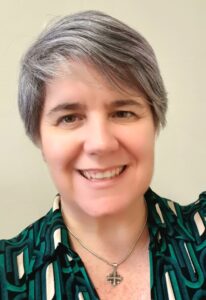 Julieann Moran was appointed the General Secretary of the Synodal Pathway for the Catholic Church in Ireland in September 2022. Previously she was the National Secretary for the Society of Missionary Children at Missio Ireland, where she raised mission awareness and developed evangelisation resources for dioceses, parishes, and Catholic primary schools across the island of Ireland. Originally from Newbridge, Co Kildare, Julieann has worked in the faith, hospitality and legal sectors. She holds both a Baccalaureate in Theology and Arts, and a Master’s degree in Faith and Culture from the Pontifical University, Maynooth, as well as a Certificate in Social and Human Studies from Maynooth University.
Julieann is the Irish President of the European Laity Forum, a lay-led international assembly of representatives of national laity committees and councils. She is an executive member of the National Mission Council of the Bishops’ Conference and a member of the National Steering Committee for the Synodal Pathway for the Catholic Church in Ireland. Previously, Julieann worked as Project Officer and Research Assistant for the Council for Pastoral Renewal and Adult Faith Development of the Bishops’ Conference. During that time she was a member of the National Faith Development Team, the Youth and Young Adult Committee, and the Implementation Committee for Share the Good News: National Directory for Catechesis in Ireland. Julieann possesses a wealth of expertise from her roles in pastoral renewal and faith development including managing consultative processes, implementing operational plans and communication strategies, as well as skills relating to safeguarding, compliance and governance matters. Julieann’s experience includes working with children, young adults, parishes, pastoral workers, clergy, religious and educators.
Following her appointment, Julieann said, “I am delighted to be appointed to this very significant role, and grateful for the opportunity to help shape the next steps taken on this synodal journey. As we continue to reflect upon our preparations for the Universal Synod, and what we have learnt so far in Ireland about who we are as a people of God, I look forward to working with as many people as possible in further outreach, consultations, and spiritual conversations for the Synodal Pathway. This will be a demanding task but a synodal Church is a Church that reaches out and listens: listens to God and listens to one another. With prayer, patience, and the Holy Spirit, I am convinced that synodality is essential in a Church that nurtures and renews the Gospel message of Jesus Christ today.”
Julieann can be contacted at [email protected]
Former Steering Committee Members
Nicola Brady (Chair) is General Secretary of Churches Together in Britain and Ireland.
Paul Dempsey is Bishop of Achonry.
Josephine Enenmo is a Religious Sister of the Missionary Congregation of Our Lady of Apostles.
Stephen Farragher is a priest of the Archdiocese of Tuam.
Martin Hayes is Bishop of Kilmore.
Declan Hurley is Vicar General of the Diocese of Meath.
Julie Kavanagh is a member of the Diocese of Kildare and Leighlin Faith Development Services team.
Brendan Leahy (Vice-Chair) is Bishop of Limerick.
Julieann Moran is General Secretary for the Synodal Pathway of the Catholic Church in Ireland.
Dermot McCarthy is a permanent deacon in the Archdiocese of Dublin.
Paula McKeown is the Director of the Living Church office in the Diocese of Down and Connor.
Gerry O’Hanlon is a Jesuit priest and theologian.
Nuala O’Loan is a member of the House of Lords and a qualified solicitor who has served on multiple public bodies, national and international, with particular focus on policing and police accountability.
M. Louise O’Rourke is a Religious Sister with the Disciples of the Divine Master.
Jessie Rogers is a Scripture scholar and Dean of Theology at St Patrick’s College, Maynooth.
Michael Router is Auxiliary Bishop of Armagh.
Peter Sands is an educationalist, specialising in Educational Leadership, and has held leadership roles in Catholic youth initiatives across the island of Ireland.
Former Synodal Task Group Members
Patricia Carroll is the Director of Mission and Ministry in the Archdiocese of Dublin
Sheena Darcy is Diocesan Secretary for the Diocese of Elphin
Eamonn Fitzgibbon (Convenor) is a priest of the Diocese of Limerick and Director of the Irish Institute for Pastoral Studies
Janet Forbes works in pastoral ministry and is a recent graduate of Boston Colleges School of Theology and Ministry
Our logo
The Story Behind Our New Logo
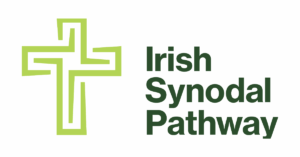
When the Irish Synodal Pathway embarked on the journey to renew its visual identity, the invitation to tender called for a logo that would be theologically rich, spiritually resonant, and distinctly Irish. The vision was to create something timeless yet contemporary, a symbol that would express unity, participation, and mission while remaining open, inclusive, and grounded in the Christian and Celtic heritage of Ireland.
In the early stages of development, the design team explored many of the visual ideas proposed in the tender. However, as the process evolved, it became clear that including too many elements risked creating an illustration rather than a logo. At the heart of the final design lies Saint Brigid’s Cross, a symbol deeply woven into both Irish culture and Christian tradition. Within its familiar form, the designer traced a pathway, a visual metaphor for our shared synodal journey. The lines move in and out, suggesting openness, dialogue, and movement, a Church that listens, learns, and walks together. This sense of the pathway reflects the inclusive nature of synodality, a journey that welcomes all and remains open to the guidance of the Holy Spirit.
The cross itself preserves the Christian foundation of the Synodal Pathway, while its geometric simplicity conveys modernity and adaptability. The use of two shades of green, in both the image and the wording, roots the design in the Irish landscape, with a gentle echo of life, renewal, and growth.
Importantly, we made a deliberate decision not to use human figures in the design. We recognised that any depiction of people, however well-intentioned, might risk excluding others. Instead, the cross and its flowing pathways invite everyone to see themselves within it.
In the end, the new logo embodies an Irish expression of the universal call to communion, participation, and mission. It is both rooted and forward looking, grounded in faith and alive with movement, holding tradition and transformation together in an unfolding journey.
Scéal Ár Lógó Nua
Nuair a theastaigh ó mBealach Sionadach na hÉireann a amharc-aithne a athnuachan, thugadh cuireadh do ealaíontóirí agus dearthóirí lógó a dhearadh a bheadh saibhir ó thaobh na diagachta agus na spiordáltachta de, agus a bheadh Gaelach go soiléir. ‘Sé a bhí á lorg ná siombail a bheadh suthain agus comhaimseartha, a raibh ar a chumas comaoin, rannphairtíocht, agus misean a chur in iúl, agus ar féidir leis ag an am chéanna bheith oscailte, cuimsitheach, agus fréamhaithe i n-oidhreacht Chríostaí agus Cheilteach na hÉireann
I dtús báire, rinne na dearthóirí iniúchadh ar na téamaí éagsúla a bhí molta ag an mBealach Sionadach. Ach, de réir mar a chuaigh an próiséas ar aghaidh, tháinig sé chun cinn go raibh an iomarca eilimintí sa tairiscint. An baol a bhí ann ná gur léaráid a thiocfadh amach ón bpróiséas in ionad lógó. Faoi dheireadh, tá crois Naoimh Bhríde i gcroílár an dhearaidh, ós rud é gur siombail í atá fite sa chultúr Gaelach agus sa traidisiún Críostaí. Laistigh de fhoirm na croise, léirigh an dearthóir cosán nó bealach chun ár mbealach sionadach a chur in iúl. Bogann na línte isteach agus amach, ag léiriú an oscailteacht, an comhphlé, agus an gluaiseacht a bhaineann le hEaglais atá ag iarraidh éisteacht agus foghlaim, agus a bheith le chéile ar an mbealach. Léiríonn sé seo nádúr cuimsitheach Eaglaise shionadach, a chuireann fáilte roimh gach duine agus a ligeann í fhéin bheith faoi threoir an Spioraid Naoimh.
Coinníonn crois Bhríde na bunclocha Críostaí den Bhealach Sionadach, agus cuireann a cuid línte geoiméadracha an nua-aoiseacht agus an inoiriúnaitheacht in iúl. Úsáidtear dhá dhath glas – sa chrois agus sa téacs – chun an lógó a fhréamhú i dtírdhreach na hÉireann, agus é ag tabhairt macalla don bheatha, don athnuachan, agus don fhásóg.
Thar aon rud eile, bheartaíodh gan figiúirí daonna a úsáid sa dearadh. Thuigeadh go raibh an baol ann daoine a eisiaigh, cé chomh chuimsitheach agus a theastaíodh a bheith. Ina ionad sin, tugann an chrois, agus an cosán atá fite tríd, cuireadh do gach duine é féin nó í féin a aithint inti.
I ndeireadh thiar thall, léiríonn an lógó nua an ghairm uilíoch chun comaoine, rannpháirtíochta, agus misean a thugtar do gach Críostaí. Tá sé socair ach faoin am céanna ag breathnú chun cinn; tá sé socair sa chreideamh ach tá gluaiseacht ann leis; coiméadann sé an traidisiún agus an claochclú le chéile, agus muid ar an mBealach atá á nochtadh ós ár gcomhair amach.